
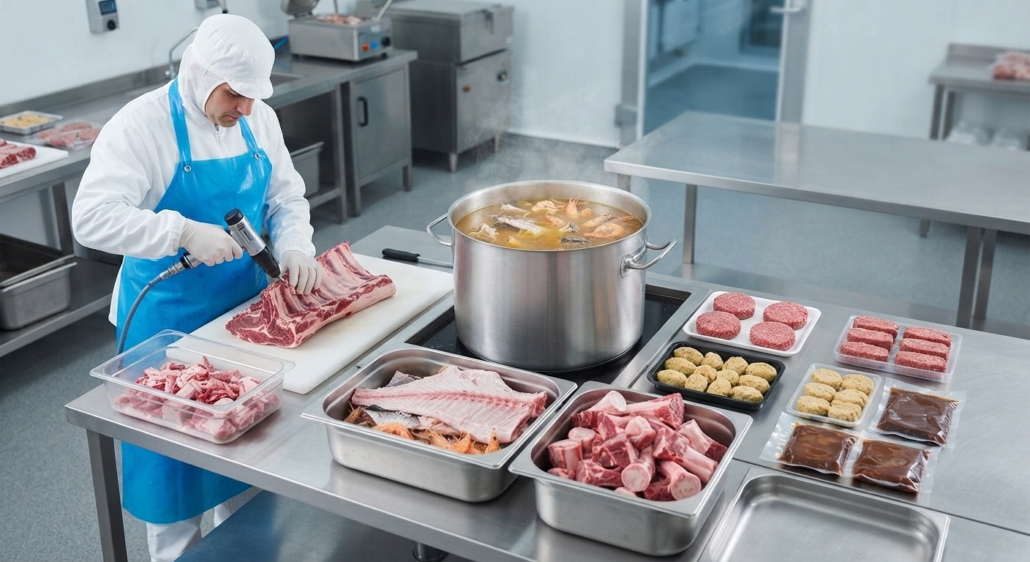
How to Maximize Yield from Every Cut: Ideas to Profit from Trimmings, Bones, and Fishbones (Broths, Stocks, and Processed Foods)
In the modern meat and fish processing industry, plant profitability no longer relies solely on selling prime cuts or center-cut fillets. True profit margins and economic sustainability lie in applying a whole-carcass utilization philosophy—transforming what were traditionally viewed as low-value by-products or waste (trimmings, bones, frames, and fishbones) into highly profitable product lines.
1. From Trimmings to High-Value Meat and Seafood Preparations
During breaking, trimming, and filleting, small pieces of clean muscle and fat are inevitably generated. Far from being relegated to low-margin rendering, these trimmings serve as the ideal raw material for high-demand consumer goods:
-
In the meat sector: Selected ground meats, gourmet burgers, meatballs, fillings, and fine emulsions for cooked or cured sausages. Using precision pneumatic tools in the boning hall allows operators to trim closely along the bone, recovering clean, splinter-free lean meat.
-
In the seafood sector: Loin trimmings left after skinning and portioning are ideal for manufacturing fish cakes, croquettes, seafood burgers, surimi, or fillings for ready-to-eat meals.
2. Bones, Carcasses, and Fishbones: The Foundation for Industrial Broths, Stocks, and Fumets
The surge in professional foodservice and home consumption of ready-made meals has driven massive demand for natural broths, dark stocks, demi-glace, and ready-to-use fish fumets.
-
Beef, pork, and poultry bones: Following efficient deboning that removes excess soft tissue, clean bones provide the foundation for extracting collagen, gelatin, and rich flavor through industrial slow-cooking, yielding high-value concentrated stocks for the HORECA sector and food manufacturers.
-
Fish frames and heads: Clean backbones and frames resulting from filleting—particularly from white fish such as hake, monkfish, or cod—are used to produce high-quality fumets and base stocks, drastically cutting organic waste disposal costs for the plant.
3. The Role of Specialized Machinery in Recovering Every Gram
To ensure that utilizing trimmings and bone structures remains profitable and meets strict hygiene standards, plants must rely on technology engineered for speed and accuracy:
-
Pneumatic deboning and trimming tools: Enable operators to separate meat clinging to complex joints without physical fatigue, boosting meat recovery rates while leaving clean bones ready for cooking.
-
Precision skinners and derindlers: Remove only the outer skin or rind without pulling away usable flesh, ensuring downstream trimmings retain top quality.
-
Industrial cutters and grinders: Emulsify and blend recovered trimmings uniformly, achieving optimal textures for any type of processed food product.
Implementing by-product valorization strategies not only minimizes environmental impact and waste management fees, but also turns every carcass and whole fish into a maximized revenue stream.
