
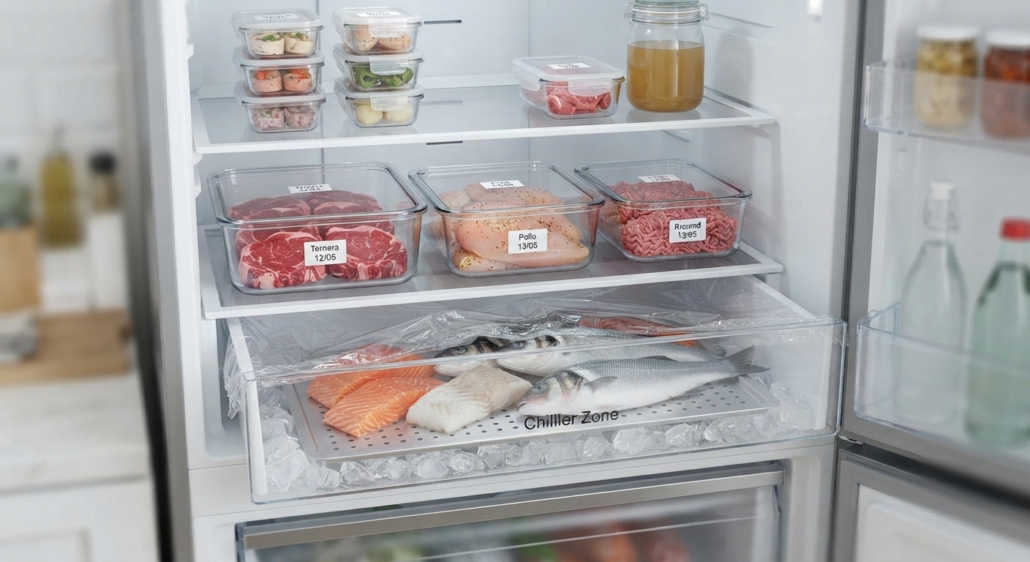
The Definitive Guide to Cold Storage: How Long Each Cut of Meat and Type of Fish Lasts in the Fridge and Freezer
Maintaining the cold chain and respecting storage times is not just a matter of food safety to prevent illness, but also the key to ensuring meat and fish retain their flavor, juiciness, and texture. Whether you manage a deli counter or organize your weekly shopping at home, knowing the exact limits for each product prevents waste and guarantees an optimal result in the kitchen.
1. Meat Storage: Times in the Fridge and Freezer
The shelf life of meat depends directly on the surface area exposed to air and its fat content. The more ground or cut up a piece is, the greater the bacterial proliferation and the shorter its shelf life.
| Meat Type / Cut | In the Fridge (0 °C to 4 °C) | In the Freezer (-18 °C) |
| Ground meat and fresh preparations (burgers, sausages, meatballs) | 1 to 2 days | 3 to 4 months |
| Whole poultry (chicken, turkey) | 1 to 2 days | 12 months |
| Cut or filleted poultry (breasts, thighs, wings) | 1 to 2 days | 9 months |
| Offal and variety meats (liver, kidneys, brains, tripe) | 1 to 2 days | 3 to 4 months |
| Steaks and chops (beef, pork, lamb) | 3 to 5 days | 4 to 6 months (pork) / 6 to 12 months (beef and lamb) |
| Large roasts (whole loin, round, shoulder, whole tenderloin) | 3 to 5 days | 6 to 12 months |
| Cooked or stewed meat | 3 to 4 days | 2 to 3 months |
Key Tips for Storing Meat:
-
The coldest zone: Always store meat on the bottom shelf of the fridge (just above the vegetable drawers), where the temperature typically ranges between 0 °C and 2 °C.
-
Remove absorbent paper: If you are not going to consume it on the same day, transfer it to a clean, airtight container or wrap it well in plastic wrap to prevent excess moisture from accelerating spoilage.
-
Vacuum sealing: If you use a domestic or professional vacuum sealer, the times for both refrigeration and freezing are multiplied by up to three, also preventing freezer burn.
2. Fish and Seafood Storage: Times in the Fridge and Freezer
Fish is much more perishable than meat because its digestive enzymes continue to act after capture and its fat oxidizes quickly. Furthermore, it requires even lower temperatures (ideally between 0 °C and 2 °C).
| Fish / Seafood Type | In the Fridge (0 °C to 2 °C) | In the Freezer (-18 °C) |
| Oily fish (salmon, mackerel, sardine, anchovy, tuna) | 1 to 2 days | 2 to 3 months |
| White fish (hake, fresh cod, monkfish, sole, sea bass) | 2 days | 6 months |
| Fresh seafood (shrimp, prawns, crayfish) | 1 to 2 days | 3 to 6 months |
| Bivalve mollusks (mussels, clams, cockles) | 1 to 2 days (damp mesh) | 3 months (preferably cooked or cleaned) |
| Cephalopods (squid, cuttlefish, octopus) | 1 to 2 days | 4 to 6 months |
| Cooked fish | 2 to 3 days | 2 to 3 months |
Key Tips for Storing Fish:
-
Clean it as soon as possible: If you buy it whole, ask at the fish counter or do it yourself to remove viscera and scales before storing it. The viscera are the primary source of decomposition.
-
Avoid contact with its own juices: Place the fish on a rack inside an airtight container so it is not submerged in the liquid it releases.
-
Anisakis prevention: If you are going to consume raw or undercooked fish (pickled anchovies, sushi, ceviche, carpaccio), it is mandatory to pre-freeze it at -20 °C or lower for at least 5 days in 3 or 4-star domestic freezers.
3. Golden Rules for Freezing and Thawing Without Losing Quality
-
Always label: Write the freezing date and the type of cut on the bag or container. In the freezer, all packages end up looking alike.
-
Portion before freezing: Separate fillets with parchment paper or freeze in individual portions. This way, you only take out what you are going to consume and avoid re-freezing.
-
Slow thawing in the fridge: Move the product from the freezer to the bottom shelf of the fridge 12 to 24 hours in advance, always on a plate or rack to collect the meltwater. Never thaw at room temperature or under hot running water.
-
Do not re-freeze raw: Once a raw food is thawed, it cannot go back into the freezer unless you cook it beforehand at over 70 °C.
