Types of knife sharpeners

Knife sharpeners are essential tools in the food industry. Having these tools, which are used daily, ensures that knives remain in optimal condition to guarantee precise cuts, especially in butchery.

What types of knife sharpeners are available?

From our experience, we can vouch for the quality and effectiveness of the different types of knife sharpeners available on the market.

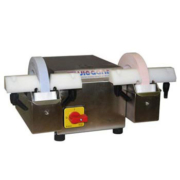
Below, we recommend two types of knife sharpeners, highly sought after for their quality and precision. These include the AC Knife Sharpener and water-cooled knife sharpener models:

  • AC Knife Sharpener: This handy model works with a belt system, ideal for sharpening all types of knives. Its quick belt-changing feature allows for both rough sharpening and finishing, depending on the need.
  • Sharpener 180/2 – 225/2 – 225/3: These water-cooled knife sharpening machines can be installed directly at the workplace, as they meet the strictest hygiene standards. They are available with 220V alternating current and 380V three-phase power.

Both types of knife sharpeners are guaranteed for their safety, precision, and effectiveness in daily work. Having them represents a valuable investment in useful resources.

By choosing the best knife sharpeners, you ensure greater productivity, high performance at work, and of course, maximum quality for the customer. Therefore, the best results depend on making a good choice.
F-1 Ham Deboner

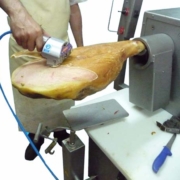
The ham deboning machine is an extremely useful tool in the food industry, specifically in butchery and delicatessen sectors. Having this type of equipment makes the laborious task of separating bones from pork shoulders and legs much easier.

Why choose an F-1 Ham Deboner?

As charcuterie customers, we understand the importance of making the right choice when bringing home a well-deboned ham. Let’s look at why the F-1 Ham Deboner is ideal for this task:

  • It facilitates and simplifies the processes of skinning, trimming, deboning, and gouging in hams and shoulders.
  • It is easy to use.
  • It is versatile and multifunctional.
  • It includes a support to help debone the coxis and scapula areas.
  • It comes with an additional attachment that simplifies the gouging process of the femur and humerus bones.

The F-1 Ham Deboner holds the ham by the hoof, providing the operator with effective handling benefits:

  • It prevents the operator from adopting strained postures, ensuring better performance during processes.
  • It helps increase productivity.
  • It simplifies the learning process of deboning.

Having an F-1 Ham Deboner means having an ideal tool for ham processing, guaranteeing maximum quality and the best results for the customer. Additionally, the easy operation of this machine helps avoid accidents and ensures optimal use of raw materials.

The best bone-cutting shears for splitting bones

In the butchery field, it is essential to have a high-quality bone-cutting machine that ensures maximum efficiency and optimal quality of the raw materials offered to customers. For these and many other reasons, it is necessary to have CZ bone-cutting shears for splitting bones.

Why choose CZ bone-cutting shears for splitting bones?

When it comes to quality and effectiveness, choosing CZ bone-cutting shears is the best investment we can make for processing raw meat in the food industry. Let’s take a look at some of the technical qualities and features of this useful and efficient machine:

  • It is ideal for cutting the pelvic bone of fresh hams.
  • It complies with strict hygiene standards, preventing the development of mite and parasite infestations.
  • It improves the bleeding process of the meat.
  • Its physical characteristics make it easier for the operator to handle the piece. There is no need to hold the ham.
  • It performs precise continuous cuts, either on a moving conveyor belt or on the table.
  • It prevents the dangerous presence of bone splinters and unwanted residues in the ham.
  • There is no need to apply lard to the bone to carry out the process.

Choosing CZ bone-cutting shears offers multiple benefits due to its cost-effectiveness and high competitiveness in the field. It is a great investment, ideal for improving the company’s performance and productivity, as well as providing the highest quality products to your customers.

History of the Butcher’s Trade

The butcher is one of the oldest and most important professions, as a large percentage of the population has relied on it for food throughout recorded history. The trade dates back as far as Roman times, leaving a significant mark during the Middle Ages. According to historical records, the first commercial butcher shops were believed to have opened in Paris during this era. These early shops laid the foundation for the modern butcher shops we know today.

The Origin of the Butcher’s Trade

According to history, the butcher’s trade originated in Athens, but it gained greater recognition in Rome. The most highly esteemed butchers were those who sold pork, which was considered a delicacy by the Romans of that time. As mentioned earlier, the trade later reached Paris, around the 14th and 15th centuries. In France, the butcher’s guild was extensive and powerful, as they not only sold meat but also raised livestock, pigs, and poultry for future sale. Additionally, this trade was often passed down from generation to generation.

The Butcher’s Trade Today

Today, the role of the butcher can range from the traditional man behind the counter, slicing meat for customers, to the butcher working in a supermarket, often earning a minimum wage. It’s interesting to note how both the independent retailer and the supermarket employee are still referred to by the same term, “butcher.” In ancient times, butchers also faced similar economic and social realities, much like the modern distinctions we observe today.